Welcome!

This little nook of the internet is going to focus on different pieces of text that center around World Literature up to the 1500's. The books that will be covered include: Gilgamesh, Odyssey, Aeneid, The Song of Roland, an Arthurian Romance, and Dante's Inferno. Each of these pieces of literature are centered around different literary techniques and styles that are incorporated into more contemporary writings of today.

Showing posts with label Arthurian Romance. Show all posts

Thursday, July 31, 2014

Arthurian Romance-The Knight with the Lion

     Chrétien de Troyes completed the whole piece of  The Knight with the Lion. In turn the poem does not have a prologue. The Knight with the Lion has intertextual references that are linked to The Knight of the Cart and it is agreed upon that these two works were created around the same time. This literary technique helps to cement the story and make it more legitimized. The connection between the two stories help to create a larger world that the read is able to explore more in depth. Yvain takes on the conflict of two separate forms of love. Instead of following his bride, which was a staple form of story telling in this time, he searches for love through his pursuit of glory. Chrétien was able to tell this story in a manner that made the audience think about the status quo.
     King Arthur holds his court at the time of Pentecost. After the meal Calogrenant, a knight, tells a tale of disgrace. Sir Kay mocks the knight at first because the story teller was the only knight to stand in the queen's presence. This being the same seneschal that was seen in The Knight of the Cart, his attitude ridicules the ideas of Calogrenant, which is a stark contrast to his character in Lancelot. Calogrenant continues with his tale.
     He was riding in Broceliande forest looking for adventure when he came across a treacherous path. He rode along this path for a day when he came upon a fortress. The owner gladly hosted the knight for the night. the next morning Calogrenant left his host and come across some bulls fighting amongst themselves. He kept his distance and crossed paths with a ugly peasant. The stranger alarms the peasant, who stands up upon a tree trunk.
http://www.les-mondes-de-gwenn.fr/2011/
05/23/le-recit-merveilleux-du-chevalier-calogrenant/
Calogrenant ask the peasant who he is and if he knows of any adventure suited for a knight. The peasant tells him of a mysterious spring that when its water is cast upon a mystical rock a storm will rise up like nothing he has ever seen. The knight rides away and finds the mysterious tree. Out of curiosity, he sprinkles water on the stone and a great storm rises up. Calogrenant states that he was fearful for his life and was blinded by the lightning strikes. After the storm had ceased a loud knight came along the path and challenged Calogrenant. The fight was short lived and Calogrenant was quickly overthrown. He was able to travel back home but his shame was so great that he held onto this story until this very moment.
      Yvain is insulted that his cousin, Calogrenant, had not informed him of this embarrassing story and he plans on going forth in order to avenge his cousins honor. Kay makes fun of Yvain's boisterous words and is silenced by the queen. King Arthur then enters the room and is retold Calogrenant's story by the queen. Arthur then swears that he will go to see this magical tree and spring. He offers to take any knight who wishes to accompany him. Yvain is upset by this oath, as he sees that it is his duty to fulfill this adventure alone. He takes off immediately in order to gain some distance between the rest of the men.
     Yvain follows the steps of Calogrenant to the letter. He meets the powerful knight at the beautiful tree and engages in a battle. Yvain gets the upper-hand by striking the knight with a hard blow to his helmet that opens up his head. Knowing that he must escape the unnamed knight rides off with Yvain close behind. They enter into the knight's castle where Yvain is thrown off his horse. He is warned by a maiden that he is in grave danger because he served a mortal blow to the knight. She promises to assist him because he was kind to her at Arthur's court. She gives him a ring that makes him invisible to the naked eye. He stays in one spot and is able to observe the people's mad search for the murderer.
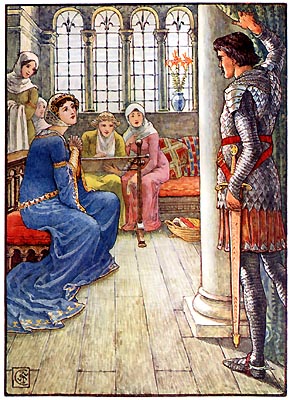
      The lady of the house is the most beautiful woman Yvain has ever seen. Only after the funeral processional leaves the room while he is hiding, does he look out the window at this woman who was in grief. The girl who helped Yvain, leaves the knight and joins the funeral in order to shy away from suspicion. Yvain is conflicted because he loves the woman who hates him. Chrétien personifies love as a woman taking over the very being of Yvain. His description helps the audience understand the magnitude of this love that Yvain is feeling. Yvain watches out the window as everyone leaves the grave except the lady of the castle. He has a war within himself about how to handle this love and if it is possible to not obey its motives. Shame and Love keep him imprisoned in the castle. Kay and the other knights would not believe that he had slain the mighty knight without any evidence
http://www.earlybritishkingdoms.
com/bios/yvain.html
and he would be shamed, but Love of the Lady holds him fast in the walls. For his only wish is to see the woman even if it means imprisonment. The servant girl who helped Yvain has always spoken openly with the lady of the house and through her cunning words she is able to convince the woman that the knight is truly worthy of her presence. Yvain is cleaned up by the servant who revitalizes his image. She takes the knight to her lady and he asks for forgiveness. Through the witty words that had been previously spoken by the servant, the Lady of the house willingly forgives the knight and ask him what imprisons him. He confesses his love for the lady and she gladly takes him to the towns people who are overjoyed by the fact that they have a new protector. The two are married.
     King Arthur and his men make their way to the mysterious spring. Kay makes fun of Yvain because he is nowhere to be found. Yvain goes to the spring in order to "protect" the land from the King of Britain and Kay gets the chance to fight the "strange" knight. He is thrown off his horse and in order to delineate from any further battle Yvain reveals himself to his comrades. Yvain relays all that has happened and asks Arthur and his men to join him at the castle. The towns people are overjoyed and celebrate. Gawain is among Arthur's men and is enamored by Lunete, the girl who hid Yvain. She tells Gawain of all that happened and how she convinced her lady to take Yvain "...as her husband" (325). They stay there a week and as Arthur prepares to leave his people they try to convince Yvain to journey back with them. Sir Gawain challenges Yvain's idea of love and tries to convince the knight that love of glory and honor is greater then that of a woman. Chrétien is able to bring up the conflict between armes (honor) and amors (love). Yvain goes to his wife and ask to take leave with Gawain in order to fulfill his love of glory and honor in his young age. She grants him this but states that he must return within a years time in order to keep on good terms with her. It amazes me how often the measure of time that is used is a single year. With the influence of Gawain, Yvain stays away longer then the time allotted. He is then faced with one of the lady's damsels who curses the man who went back on his word. The damsel demands the ring that Yvain's wife had gifted him before his travels began. She snatches up the ring and leaves.
     Yvain goes mad at the thought of losing his love. A hermit sees Yvain, who has become a wild-man, and helps him by feeding him bread. After sometime the Lady of Norison finds Yvain naked under a tree. She sends one of her damsels with a special ointment to cure the knight's maddened mind. He becomes alert again and follows the damsel to the lady's castle. There Yvain is nurtured back to full health. Luckily when Yvain is fully healed he is able to help defend the town from the Count Alier. Yvain abilities as a knight prove to benefit the town and his success helps to build up the courage of the other warriors. Eventually Yvain corners Count Alier who surrenders to any terms that Lady Norison lays out. After taking the prisoner to the Lady, Yvain leaves amidst the pleas of the townspeople.
http://d.lib.rochester.edu/camelot/theme/yvain
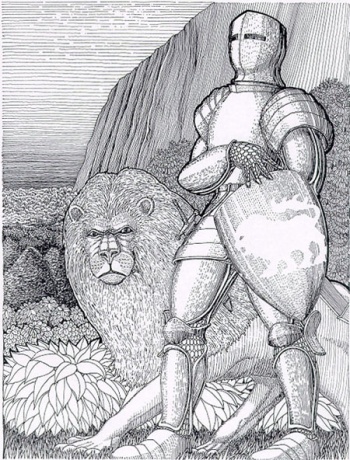
     He travels for some time until he hears "...a very loud and anguished cry" (337). The knight comes upon a lion being attacked by a dragon. Not knowing if the lion would attack after he was freed, Yvain slays the dragon in order to help the suffering animal. Instead of attacking its savior the lion bows down in submission. From that day forward the lion would follow Yvain out of servitude. The beast would hunt for food that Yvain would then cook and at night the lion protected his master and his master's horse. This cycle continued for two weeks until Yvain came upon the spring and stone that had started his whole adventure. He fainted at the sight and his loving pet believed him to have died. Before the lion could do anything rash Yvain woke up and stopped the animals attempt at suicide.
     Yvain laments about his lost love and how he should die. A prisoner hears his words and calls down to him. Lunete, the woman who saved Yvain when he was trapped in the castle, ends up being this prisoner. She tells Yvain of Kay's evil scheme to be rid of her, because the queen trusts Lunete's word more then Sir Kay's. The seneschal uses the queen's distrust of Yvain as a way to catapult Lunete into prison. Yvain ask why Gawain did not help this "...damsel in distress" (341). Lunete relays information that relates this story back to The Knight of the Cart. Sir Kay lost the queen, so Sir Gawain went out to find Meleagant, her captor, therefore he is not to be found in court. Lunete is scheduled to be burned or hanged the next day. Yvain vows to return in order to fight for Lunete's freedom and finds lodging at a obscure stronghold.
     All the homes and huts had been taken in side the massive walls and while the people greet Yvain with joy they continually fall into grief. Yvain's curiosity gets the best of him and he is forced to ask the lord of the town what bothers the townspeople. The lord tells of Harpin of the Mountain, a giant, who had been terrorizing the city and forces everyone into the castle walls. The giant demands that the lord's daughter be given to him. The six sons of the lord had tried to defend the city but to no avail. Yvain asks the leader about Sir Gawain but is again told a shortened version of The Knight of the Cart. Our humble knight finally agrees
http://www.timelessmyths.com/arthurian/tales.html#YvainFountain
to take on the giant himself. The lady of the house and the beautiful daughter join the men. Throughout this story Yvain continually focuses on the idea that things are to happen only if it is God's will. In Lancelot, the main character was driven by the wishes of the woman he surrounded himself with, Yvain's adventure changes depend on women's needs to some extent but are also supplemented by God's will. Yvain tells the lord that he is willing to fight the giant if he is at the castle before a certain hour because he had already given his oath to Lunete.
     The next day Yvain was torn between staying or leaving because the hour had come. After much pleading from the lady and her daughter, Yvain is still torn. Thankfully the giant shows up to demand the girl. Yvain kills the giant with the help of his lion. He then prepares to leave to his next task and ask the lord to get word to Sir Gawain of his success.
     As he enters the chapel, Lunete is tied up and about ready to be put into the fire. Yvain charges in yelling, "Release her! Release the girl, you wicked people! It's not right for her to be burned at the stake or in a furnace, for she has done no wrong" (349). The knight defeats the men who swore against Lunete, with the help of his lion. After the duel, Yvain leaves with his lion only after his love grants him her good-will. He departs from the chapel with only Lunete knowing his true identity. Yvain arrives back at his previous lodging where he is gladly taken in to start the healing process. He stays with these people until he is healthy and strong.
     Lord of Blackthorn dies and his eldest daughter takes control over all the land. His youngest daughter contest this use of power and threatens to seek help at Arthur's court. The oldest, determined to reach the court before her sister, sets out at once to seek Arthur. She is able to reach the court and discuss with Sir Gawain their terms. He agrees to help the power hungry sister and when faced with the youngest sisters request for help he refuses to go back on his word. News of "The Knight with the Lion" surfaces at Arthur's court and the youngest sister becomes determined to find him in order to defend her inheritance. She travels for days and becomes ill. She is given lodging and while she rest a servant is sent out to track down Yvain. The servant comes across the lord that was aided by Yvain when he killed Harpin of the Mountain. The lord directs her to Lunete who gives her directions that take he directly to Yvain. After catching up to Yvain the servant explains the situation and the knight graciously takes on the younger sister's cause. As the two travel with the lion at their side they come across the town of Dire Adventure. While the trio moves through the town many townspeople warn them to turn back and not to take lodging with their king. Yvain, with an innocent heart, does not listen to these words and proceeds to the building. Once at the gates, he climbs the wall to look into the meadow. He is greeted with the sight of maidens dressed in poverty working their hands to the bone in order to please their master. Yvain goes into the meadow in order to learn how these maidens ended up in such a wretched place.
     He learns the castle is owned by two men who were made from a woman and a demon. These men captured a king and in order to gain his freedom the king promised to give these terrible men 30 maidens every year. The only way for the maidens to be set free is if a knight is able to defeat the two demon-men. Step in Yvain. He promises to meet these men and if it is in God's plan he will defeat the masters of the house. Yvain walks around the castle and encounters none good or bad. He finally walks in on a daughter reading a romance to her father and mother. The knight is greeted with blessings and is given every honor that is to be bestowed upon a visitor by the daughter. After a night of good food and rest Yvain awakens and prepares to leave. The king informs him that in order to gain his freedom he must defeat the two demon-men. Before the battle begins Yvain is forced to place his pet lion in a holding room because he is only allowed to face his enemy alone. As the battle rages on the lion can sense Yvain's need for help and tunnels under the door in order to attack one of the men. While the second man tries to save his comrade the knight sees a weakness in his armor and takes this opportunity to strike him down. The first demon-man that was attacked by the lion asks Yvain to call off his lion and admits defeat.
    The townspeople are ecstatic about the upset and gather around Yvain, stating that he is now required to marry the princess. Yvain, remembering his duty to Blackthorn's daughter, refuses the marriage and in-turn upsets the king. The king goes to the extreme of demanding he marry his daughter or Yvain would become their prisoner. The knight is persistent and tries to compromise by stating he will return at the appointed time to take the girl's hand. This does not sit well with the king and he tells Yvain that he can leave and it does not matter if he returns.
      Yvain takes the maidens he had seen in the meadow and leads them out of the town and on their way home. The knight then rides off in the opposite direction behind the servant girl who originally had requested his help. The trio makes it to the lodging where the youngest sister had just recently recovered from her illness and their was much rejoicing. They left the next day and made it to Arthur's camp. That night they stayed in lodging outside the camp in order to hide their identity.
http://d.lib.rochester.edu/camelot
/text/han-the-legend-of-yvain
      The next day the oldest sister tries to speed things along in order to guarantee her the fullest inheritance, but the king feels sorry for the younger sister and sees through the lies of the oldest. He forces the court to wait out the full time allotted and as he decrees this The Knight with the Lion and the younger sister walk into the court. The younger sister tries to gain her rightful inheritance without bloodshed but the controlling, older sibling refuses to hear her words. The knights prepare for battle and sadly do not know the identity of their enemy. Chrétien goes into great detail about the love and hatred the men have towards each other. Their love has always been and only because they lack the knowledge of who their opponent truly is do they harbor hatred towards one another. The battle is an equal match and continues on throughout the afternoon. The men finally stop fighting when night is upon them.
     Thankfully Yvain and Sir Gawain begin to discuss the battle and soon learn of each others' names. The two knights embrace and both admit to being defeated. The king and barons are rather confused as to what this rejoicing means. The knights explain what had happened and the king is placed in an odd position. In order to scare the oldest sister into given away some of the inheritance, the king threatens to announce Gawain's defeat. This would be a mortal blow to the reputation of the oldest sister therefore, she willingly gives away part of the land. As Gawain and Yvain have their armor removed the lion runs through the court towards his master. The sight of this animal frightens many but they are reassured by Yvain's words of the lion's gentility. The two knights are taken to the best physician in the land and are healed of their wounds.
     Yvain then feels pressure to seek out his love. His plan is to make such a storm from the spring water and stone that his lady is forced to reconcile with the knight. He leaves with only his lion as company and begins to create a tremendous storm. Lunete is called to council her Lady in order to stop the terrible weather. She is able to tell her Lady of a knight who is well-known amongst the land but is stricken by grief and sorrow. Lunete believes if the knight were to be reconciled with her mistress he would be willing to defend the town. The Lady agrees to help this infamous knight, only knowing him as The Knight  the Lion. Lunete sets out to find Yvain and comes upon him sitting underneath a pine. She tells him of the lady's oath and travels with him back to the fortress. Lunete, Yvain, and his pet lion travel into the city and head to the noble lady. After learning of his true identity the woman feels tricked but is forced to reconcile with the man.
The poem ends with:

"The Chrétien brings to a close his romance of the Knight with the Lion. I've not heard any more about it, and you'll never hear anything more unless one adds lies to it."

Note: William W. Kibler's translation was used for reference.

Monday, July 28, 2014

Arthurian Romance - The Knight of the Cart

      It has been accepted that this story, written by Chrétien de Troyes, was forced upon the writer by Marie de Champagne. A main reason for this acknowledgment hinges on the fact that he blatantly states this inconvenience in the opening prologue.  Chrétien's ideology of love also helps to concrete his resistance to this demand. The Knight of the Cart, also referred to as simply Lancelot, has a more contemporary view of love especially outside of marriage. Chrétien believed highly in the ideals of the church and saw any romance/love outside of marriage as adultery. The story is known as a "a popular Celtic abduction story, or aithed" (10). Chrétien was able to allude to the "tragic love tale of Piramus and Thisbe" in order to legitimize his knowledge of classic material.
http://www.geocities.ws/jessica12_80/plot.html
       At Camelot, King Arthur holds his court. It is quite extravagant including everything you would expect of a king. King Arthur is greeted by a mysterious knight who comes into court dressed for battle. The knight, later known as Meleagant, addresses the king and tells him of all Arthur's loyal subjects he has imprisoned. He does not intend to give them back but tells the leader of an ultimatum. "Sir, if at your court there is even one knight in whom you have faith enough to dare entrust the queen to accompany her into these woods where I am going, I give my oath that I will await him there and will deliver all the prisoners who are captive in my land -- if he is able to win the queen from me and bring her back to you" (208). Another knight, only known as Kay, hears this challenge and immediately goes to the king and tells him of his departure from the court. The king is sad and tries to stop Kay, but the knight is firm in his resolve. King Arthur finally asks the queen to convince Kay to stay and she approaches the knight while he sits with his comrades. The knight is determined to travel onward. He only agrees to stay after the queen refuses to rise and she promises to grant his mysterious request. After proceeding to the king, Kay request to fulfill the desired challenge from the illusive knight. With a heavy heart Arthur agrees. Kay's request is seen as being "...proud, rash, and foolhardy" (209). The queen and Kay prepare to leave.
      Nobody attempts to follow the duo until Sir Gawain publicly tells King Arthur that someone must follow in order to learn of the queen's final whereabouts. He also is concerned about how prepared Kay is for the duel. After the king agrees to ride with Sir Gawain many of the townspeople volunteer to help. Gawain goes on his own path and meets Kay's horse. The animal is riderless and many of the parts to the saddle are destroyed/stained with blood. Gawain continues riding on into the forest and he meets a name-less knight, later on known to be Lancelot, who is riding a labored horse. The stranger greets Gawain and asks to either loan or be gifted one of the extra horse accompanying the pursuer. Gawain gives the knight whatever horse he chooses, but his choice is hastily made and the horse dies soon into his travels. Lancelot is then forced to ask a dwarf for information of his lost queen. The dwarf refuse to give him any knowledge of the queen but in turn states that if he were to travel in his cart he would divulge information. Carts are a social symbol during this time period. These modes of travel were scarce and therefore reserved for criminals. If one was seen on a cart they would lose all of their feudal rights as well as never be allowed in court again. Lancelot hesitates for a moment, but ultimately decides his honor is worth less then the queens life. This decision helps to shape the rest 
http://www.sjsu.edu/people/cynthia.rostankowski/courses/hum1b/
of the piece. It gives the literature its title, as well as a basis for Lancelot's character. Sir Gawain comes upon the unlikely duo and is appalled at the thought of riding with the dwarf. Instead, in order to learn of queen's location, he follows the cart. They go into town where Lancelot is ridiculed and mocked. They continue on until they reach the dwarf's lodging. Sir Gawain is greeted warmly by an attractive girl who then asks what Lancelot did to deserve passage in the cart. This question will continually be a point of interest for many onlookers throughout the literature. The dwarf silently leaves the room and the two men take off their armor, fill their bodies with nourishment, and prepare for bed.
     The next morning Lancelot sees his queen through a window as she proceeds in a funeral march on horseback by her captor. Sir Gawain is able to stop Lancelot from doing anything rash and the two prepare to follow the funeral procession. They ride until mid-morning and meet a girl who is willing to tell them the location of the queen. She warns the men that the road will be dangerous and anyone who rides into the land will suffer many tribulations. She requests a promise from each man in exchange for the information and the men agree to these terms. She then explains the two passages that lead to Meleagant, the prince of Gorre. She warns the men that no one has ever returned from the land with out the kings consent.  The two ways include "The Underwater Bridge" and "The Sword Bridge". The first one is a bridge that is exactly in the middle of the water with the same amount of water above as below. The second has never been crossed by a man because "it is like a trenchant sword" (215). Lancelot asks which way Gawain will attempt. After picking The Underwater Bridge Lancelot chooses the other passage. As the men ride away the girl reminds the travelers of their promises to help at a time of her choosing. The two men hear and  vow to keep good on their word.
     At this point in the story Chrétien has our hero encounter people, predominantly women and knights, who challenge his character and loyalty to his love, the queen, and his ability to continue in his quest for her safety.  It amazes me how reliant men, especially knights, were on the women of the time. Lancelot continually is influenced by the wishes of the women who surround him but ends up finding ways to  better his reputation. As the story moves forward Lancelot comes upon a church
http://ladaria.livejournal.com/461874.html
 and the knight enters to pray. On his exit he meets an elderly monk who takes him to the cemetery. Lancelot sees the graves reserved for Gawain and Yvain. Chrétien is able to use intertextuality to give more relevancy to his stories and create a broader literary world. The pair comes across a tomb that helps to foreshadow the success of Lancelot. The knight is able to lift the massive stone away from a tomb that was prophesied only to be opened by the person who would emancipate the  prisoners of Meleagant's land. The monk is amazed and tries to learn of the identity of the mysterious knight, but Lancelot is able to hold on to his identity. Chrétien continues with Lancelot's encounters with different strangers. At one point Lancelot is forced to decided between Generosity and Compassion when faced with a duel. He finds a loophole in his logic and is able to satisfy both areas of his compassion. This occurrence helps the reader to understand the eternal war that goes on in our hero. The humble knight crosses the Sword Bridge with minimal injury.
     King Bademagu, ruler of Gorre, watches his passage with Meleagant, his son. The king is known for being the exact opposite of his son in all of his mannerisms. He tells his son to welcome this brave knight and to be hospitable to the warrior. Meleagant refuses to give in and hand over his "prize", Queen Guinevere. Bademagu tells his son that he will receive no help from him in order to defeat the knight and the only man who Lancelot should fear is Meleagant. The king rides down to talk with Lancelot and tries to convince him to let his wounds heal before their duel. Lancelot is determined to follow through with his journey quickly and only commits to wait until the next day for the impending battle. People from all over the land hear of the upcoming fight and flock to the castle.
     The next morning the battle begins in a frivolous manner and prayers are said for both men. As the battle starts and progresses it is apparent Lancelot is losing. This may be in part because of his injured hands. Queen Guinevere realizes her influence and learns the name of the knight who is
http://www.literaryramblings.com/1000-books-in-10
-years-vol-291-the-knight-of-the-cart-by-chretien-de-troyes
 fighting for her safety. She shouts out to Lancelot and distracts him. He becomes entranced by the queen and she helps him maneuver himself in order to see the her while also fighting Meleagant head on. Lancelot starts to take the upper-hand and Bademagu asks the queen to sway Lancelot so that he will not kill Meleagant. She agrees because of his kindness throughout this whole ordeal. Lancelot immediately listens to the queens words and Meleagant takes advantage of the situation and attacks Lancelot even though the knight had stopped pursuing him. Bademagu stops his son and orders his men to hold him back. The king refuses to let his son use his arrogance as an excuse for his actions. In order to appease both parties the two knights agree to another duel this time in King Arthur's court in less then a year. Queen Guinevere will be freed and given to Lancelot until the next duel where her hand will be up for grabs, again. Lancelot is then taken to the queen who is angered with the knight. He lets the queen leave with a heavy heart.
      Our knight is then taken to Kay, who is ashamed to talk with Lancelot. His shame stems from Lancelot being able to complete the task he failed. The seneschal, Kay, informs Lancelot of the drastic difference between King Bademagu and Prince Meleagant. Lancelot then takes his leave and prepares to search for Gawain. He takes with him the volunteer prisoners he freed and Lancelot's legacy is born with his partial defeat over Meleagant. He now has opened the borders of Gorre and allowed people to freely travel in and out of the land.
      As Lancelot reaches the border he is captured by the people of Gorre and held captive. Word is taken to the King of the events but he is also told that Lancelot was killed. The king is outraged. Queen Guinevere learns of Lancelot's "death" and becomes distraught. She stops eating and talks about killing herself. Rumors fly back to the captors and Lancelot is told that the queen did kill herself. This melodramatic scene alludes to Shakespeare's Romeo and Juliet. The two lovers are hysterical over news about the other's so-called deaths. Thankfully his captors stop Lancelot's suicide attempt and as the captors get close to the city both parties are informed that everyone is still alive.
     After arriving in Gorre the king is elated to see Lancelot and places judgement on the native captors. The queen is happy to hear of her lovers return and losses all preconceived judgments about the knight. The two are given time to talk and Lancelot finally asks the queen why she was so cold. She responds,"Were you not shamed by the cart, and frightened of it? By delaying for two steps you showed your great unwillingness to climb into it. That, to tell the truth, is why I didn't wish to see you or speak with you" (262). Lancelot apologizes for his actions and the two plan for their next rendezvous which must be kept secret. That night Lancelot sneaks away in order to see Guinevere at her window. The iron bars placed in the window create dilemma for the lovers. Lancelot is able to move
http://myweb.tiscali.co.uk/
sherwoodtimes/guinever.htm
the bars but only after cutting his fingers open. The knight is so moved by love he does not notice the injury and falls into the arms of his queen. Chrétien describes their encounter in simple terms but in the end states that, "...I shall let it remain a secret for ever, since it should not be written of: the most delightful and choicest pleasure is that which is hinted at, but never told" (265).
      The next morning Lancelot leaves saddened that he must part from his lover. During the night his injured hand stains Guinevere's bed with blood. After getting through the window and straightening the bars he bows down to the queen as if to an altar. Meleagant enters the room and sees blood on both Guinevere's and Kay's sheets and assumes that Kay had taken advantage of the queen. As an audience we know this not to be true and that the blood on Kay's bed came from his personal wounds. The prince calls for his father and states his accusation. The king is appalled by the thought of a knight that would sleep with his queen and Kay tries to deny the action but the obvious "evidence" makes his arguments void. Meleagant refuses to withdraw his accusation and Kay calls for a duel to clear his name. Guinevere summons Lancelot, who comes to defend Kay. The duel is a replication of the previous scuffle between these two knights. Guinevere is asked by Bademagu to stop the fight and from the words that fall off her lips, Lancelot obeys. Meleagant is forced to stop his attacks and is appeased by the thought that his battle in King Arthur's court will create more shame towards Lancelot. Our knight then rides off to seek Sir Gawain.
      After traveling out of the city Lancelot is tricked by a dwarf who kidnaps the hero. His men are concerned about what to do next and they go to find Sir Gawain at the Underwater Bridge. After rescuing the man they tell him all that has happened in his absence. Gawain has the men ride back to Gorre in order to gain information from Bademagu. The king sends out search parties in order to find the lost knight, but everyone comes up short. A messenger brings a mysterious letter to the king who has the it read allowed in order to avoid confusion. In the letter Lancelot tells the people he has returned to Arthur's court and that they should journey back as well. Joy is seen throughout Gorre.
      After journeying back to King Arthur's land Gawain, Kay, and Queen Guinevere are joyfully greeted. The people congratulate Gawain for rescuing the queen but Gawain refuses to accept honor. He realizes he has been deceived and King Arthur begins to grief the loss of Lancelot until he sees then queen. The single ladies and maidens of the land organize a tournament in order to help them find husbands. They get the king to agree that the queen will be present at their event. The queen also agrees to this and word of her presence travels. While being imprisoned in Gorre, Lancelot hears of this event. The Lady of his captor's house sees that he refuses any aid and asks that he confide in her. He tells her that he wishes to attend the tournament and swears that he will return when the event has passed. The Lady is scared of the Prince of Gorre and hesitates to appease this request. After some bartering Lancelot is let go, clothed in the home owner's armor.
http://www.celtic-twilight.com/
camelot/chretien/lancelot.htm
     Our knight chooses to lodge in a cramped space in the town of Wurst. He does this in order to shy away from unwanted attention. Chrétien goes into detail about the massive amount of knights who are attending the tournament; the main reasoning behind this large influx of attendance is centered on Queen Guinevere's scheduled appearance.
      The next day at the tournament the games begin swiftly. Lancelot, disguised at "the red knight", fights so well that people begin to take notice. The queen, with her suspicions, summons a girl to tell Lancelot to fight poorly. After hearing Guinevere's request Lancelot obeys his love and begins to act cowardly. The crowd, who at first were amazed, mock our knight. At the end of the day people are still perplexed by the abrupt change in the mysterious knight and call him a coward. The next morning spectators and competitors alike flock to the tournament. Many of the knights are described but when Lancelot does not show up people assume he is to ashamed to show his face.
      Guinevere has the same girl find her beloved knight and informs him to again do poorly in the games. His response is taken back to the queen who knows without a doubt that it is Lancelot. The girl messenger then returns to our knight with another message from the queen. This time the knight is instructed to do his best,
Lancelot obliges the request and amazes the crowd. The ladies and maidens who had hosted the tournament were distraught by the fact that they all wanted to marry the mysterious knight. They refused to believe that any other man would hold up to his ability and they all went home husband-less. Our knight quickly left the tournament in order to remain mysterious and returned to the prison in order to keep his word.
     After returning back to his prison Lancelot is placed in a tower that was built, as ordered, by Meleagant in order to dissipate any possibility of our knight's escape. Meleagant then returns to Arthur's court ready for his scheduled battle with Lancelot. With no sign of the celebrated knight, Gawain offers to duel the prince after the court is given a year to search for their hero. Meleagant agrees to these terms and he returns to his father's court. Upon arrival he boast about his success in Arthur's court. Instead of praising his son, King Bademagu, reprimands his arrogant words and chastises his character. Meleagant is outraged. His father states that the only way Lancelot would not follow through with his word would be if he were imprisoned or dead. Meleagant's sisters hears this statement and resolves to find Lancelot. She rides on her mule for days on end and finally finds the tower that Meleagant constructed. She frees Lancelot and takes him to a private castle where she takes care of the knight. Our knight becomes healthier and stronger and eventually leaves his savior.
     The following day Lancelot returns to court, Meleagant appears as well in order to duel Gawain. The prince goes to the court asking if Lancelot had been found and Gawain tells the villain of the sad
http://histonotas.blogspot.com/2011
/06/arturo-el-fin-de-la-caballeria.html
news that the knight is still nowhere to be found. As Gawain prepares himself for battle Lancelot enters the court. The people are ecstatic to see their beloved knight especially the queen who forces herself to keep her distance. He tells Arthur of the torture that Meleagant put him through and refuses to let Gawain fight for him. Meleagant is stunned to see his prisoner in the court and he concludes that he will fight as best he can until he is overtaken. King Arthur moves the duel to a heath that was known as "...the fairest from there to Ireland" (293). Both knights become enraged throughout the duel but in the end Meleagant is killed. No one shows remorse for the death of the prince and they help Lancelot with his armor.

The story ends with:
"My lords, if I were to tell any more, I would be going beyond my  matter. Therefore I draw to a close: the romance is completely finished at this point. The clerk Godefroy de Lagny has put the final touches on The Knight of the Cart; let no one blame him for completing Chrétien's work, since he did it with the approval of Chrétien, who began it. He worked on the story from the point at which Lancelot was walled into the tower until the end. He has done only this much. He wishes to add nothing further, nor to omit anything, for this would harm the story."

This last paragraph helps the reader to understand the extent to which the story was edited.

Note: William W. Kibler's translation was used for reference.